Trump Says Iran Wants Deal, But Not One He Can Accept
Gulf states push for shipping access in exchange for sanctions relief as the U.S. maintains a naval blockade.
By Pablo Medina ·
President Donald Trump told reporters on Friday that Iran wants to end the war, but he does not believe Tehran is offering a deal acceptable to Washington. The conflict, which has lasted nearly nine months, shows signs of uneven escalation even as diplomatic talks stall. Trump stated at a White House news conference that he wants a real agreement rather than a fake one. He added that the Iranian government has been bullying people for 51 years and vowed that the country will never possess a nuclear weapon.
Gulf Arab states are working to prevent a return to full-scale war. A Middle Eastern diplomat spoke on condition of anonymity to describe efforts to find a partial solution. The proposal involves removing all constraints on shipping in the Strait of Hormuz. In exchange, Iran would receive limited sanctions relief and open the door to broader negotiations on its nuclear program. The diplomat noted that mediators rely on closed-door talks rather than public statements from either side.
Israel continues to push for more military action. Prime Minister Benjamin Netanyahu has urged the U.S. to restart the war or allow Israeli airstrikes on Iranian nuclear facilities and missile capabilities. Iran responded to recent U.S. drone surveillance and attacks on communications towers by widening its strikes on Gulf neighbors. Iranian forces targeted a U.S. air base in Kuwait and launched several attacks on Bahrain. These strikes followed a U.S. fighter jet hitting a Revolutionary Guard missile site on Qeshm Island in the Strait of Hormuz.
Analysts suggest neither side wants to return to the height of the fighting. Mona Yacoubian, director of the Middle East program at the Center for Strategic and International Studies, described the current moment as volatile. She pointed out that Iran is striking Bahrain and Kuwait, which she identified as the weakest Gulf countries, while avoiding the United Arab Emirates, Saudi Arabia, and Qatar. This pattern indicates a reluctance to commit to all-out conflict despite external pressure.
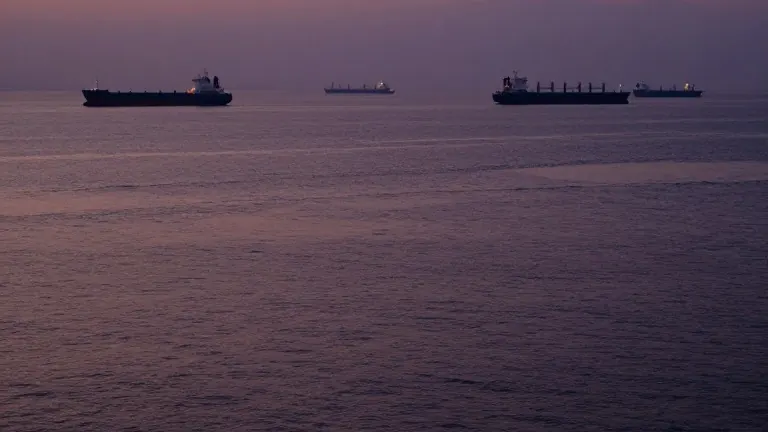
The Trump administration is maintaining a naval blockade off the waters of Iran to limit oil exports. Thousands of U.S. troops remain in the region. The Joint Maritime Information Center issued a warning this week that ships may be violating the blockade if they transferred cargo from restricted vessels or carried goods loaded in Iran. The administration is also applying economic pressure on Iran's remaining international financial ties.
Michael Singh, a former senior Mideast director at the National Security Council, called the current approach the most sustainable option available to the president. He warned that the risks of escalation are high while the returns are uncertain, citing potential casualties and rising energy prices. Trump declared the conflict militarily over earlier this month after his party lost control of Congress. Ali Vaez of the International Crisis Group noted that Tehran is determined to show Washington cannot declare victory while keeping Iran under economic siege.